Who is Jean Phil? The AI character behind the shadowboxing videos, and how to make your own
7 min read
Jean Phil, short for Jean Philanthrope, is a silent character in a brown suit, with blond hair and a curled mustache, who shadowboxes in increasingly absurd places. He went viral on Instagram and TikTok in September 2026, and the press describes him as AI-made. The creator has not been identified, and no tool is confirmed.
Who is Jean Phil?
The Instagram account is @jean_philanthrope. According to Dexerto on September 25, 2026, he appears alone, never speaks, and throws punches at the air in stranger and stranger locations. Know Your Meme, on September 24, records the earliest known video as posted on September 17, with him shadowboxing inside an apartment, and says viewers nicknamed him "poodle man."
Two videos from September 19 took off: one on a street, set to "FINIS-LES" by La Fève, and one under a tree in a Paris park, set to "Dilemma" by Nelly.
The date varies by a day depending on the source. Know Your Meme, Dexerto and the Brazilian newspaper O Tempo give September 17 for the first video, and the Belgian broadcaster VRT NWS mentions one of his first videos, published on September 18.
Is Jean Phil AI?
The press treats him as an AI character. Dexerto says he is not a real person. Know Your Meme reports that an X user claimed he was "fully AI-generated and not a real person," and that the character himself has not given a definitive confirmation.
The only account from someone claiming to be behind him is anonymous. A creator who did not give a name told VRT NWS in October 2026 that AI plays a role in the creative process, but that the videos are "not fully AI-generated" (our translation from Dutch). The creator also said they split their time between Brussels and Paris and called the character a long-term creative project.
Who made Jean Phil, and with what tool?
It is not publicly known. O Tempo, on October 8, 2026, wrote that the creator "has not been identified publicly" and that the AI tool used for the videos was not revealed (our translation from Portuguese). Dexerto, which credits his popularity to "AI edits and overlay videos that place Jean Phil into new settings," and LADbible, on September 30, also name no creator and no tool.
The same O Tempo report notes that Higgsfield has started promoting similar characters and offers a tool called Genjutsu, which inserts characters into videos that were already recorded. The report does not say Jean Phil was made with it, and no other source we read says so either. According to Higgsfield's own launch guide of August 31, 2026, Genjutsu takes one clip of 4 to 30 seconds and builds a new scene or character around its movement. What it does and what it costs is in Higgsfield alternatives.
There is another account of the profile's past. Bored Panda, on September 30, reports that Jeremy Carrasco, whom it calls an "AI literacy" guru, showed in a September 25 video that the profile joined Instagram in June 2025 and changed its username six times in 15 months. None of the sources identifies who runs the account.
Is there a Jean Phil AI generator?
Pages with that name exist. One of them, Jean Phil AI, says it is an independent fan tool and is not affiliated with the creator. O Tempo also notes that courses promising to teach the formula for viral AI videos have started to circulate. No source says which tool made the originals, so a page selling a "Jean Phil generator" can promise the look and not the original method.
What does the coin tell us about creator income?
A token linked to a character is not evidence of income from posting videos. This article does not estimate trading gains or recommend buying a token. For a content project, budget against confirmed payments and production costs, as explained in the earnings guide.
What repeats in every Jean Phil video
In the videos the sources describe, two things never change and one always does. The look is the same: brown suit, blond hair, curled mustache. The gesture is the same: shadowboxing, without a word. The setting changes every time (an apartment, a street, a park), and a well-known song plays underneath.
The structure is not unique to him. More cases are in AI influencers that went viral.
How to make an AI influencer with one fixed look and put it into real videos
Copying Jean Phil's suit and mustache only produces another imitator. The structure is what carries over: one fixed look, one repeated gesture, a new scene in every video. On Duble AI, your AI influencer (the app calls it a double) takes the place of whoever is in a real video, follows the original's movement and uses its audio as a reference, in the original's scene, which may change a little. This article does not say Jean Phil was made with Duble AI or with any other tool.
- Invent the look. On the creation screen, open the Describe tab and write, under "What they look like," a person, one strong visual detail and an attitude. Exaggerate the hair, the mustache or the clothes and keep the face and body human. Do not use the name or the appearance of a real person. Creating the influencer costs nothing, up to 3 images across tries and adjustments.
- Generate it and name it. Tap Generate double, which takes about 20 seconds. If something is off, Change something swaps one thing and keeps the rest, and Generate another draws the same description again. On the "What's it called?" screen, pick a name and tap Save double (or Save and pick a trend, if you have not signed in yet). For writing a good description, see how to create an AI character.
- Pick where it goes. On Home, the app asks which video your double goes into. Under Trending, look for a trend with the gesture your influencer will repeat. Or tap Use your own video and send a clip of 3 to 30 seconds, as MP4 or MOV, up to 80 MB, in which you do the gesture yourself somewhere new. Only send videos you have the right to use. The own-video route is in how to replace a person in a video.
- Say what plays. Under "What plays in this video?", choose "Only music or background sound" if nobody talks (the original sound plays over the finished video) or "Someone speaks or sings" if there is a voice, so the double's mouth follows it. The generate button stays off until you answer.
- Choose the quality and tap "Generate video." There are three: Standard, High and Turbo. Standard takes one to three minutes and costs 2 credits per second. A 10-second trend is 20 credits, which comes to $3.33 on the 300-credit monthly plan.
- Make the next one with the same influencer. On the finished video's page, the "Make another with" shortcut, followed by your double's name, opens the choice of the next trend. The look stays and the scene changes. To keep the face from drifting between videos, see how to keep one AI influencer consistent.
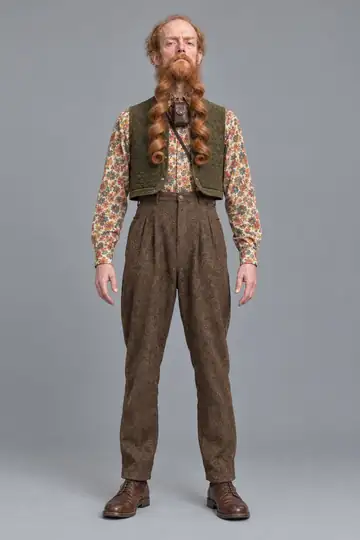
Megamente, from the cast, in three trends: the look is the same and the scene changes with every video.
Duble AI has no scene picker. The scene comes from the video you choose, and the AI may change it a little. A new scene comes from switching the trend or filming somewhere else. For speech or singing, the AI follows the source voice and the finished audio can vary; review the result with sound. For music or background sound, the original audio plays over the finished video. And nobody can promise that a video will go viral. When you post, label it as AI-made content where the platform asks, as explained in AI labels on Instagram, TikTok and YouTube.
To start, create your influencer.
Frequently asked questions
- Who is Jean Phil?
- Jean Phil, short for Jean Philanthrope, is a character in a brown suit with blond hair and a curled mustache who shadowboxes in silence in increasingly strange places. He appeared on Instagram in September 2026 and the press describes him as an AI character. His creator has not been identified.
- Is Jean Phil AI?
- The press treats him as an AI character, but the account never confirmed it. The only account from someone claiming to be behind him is anonymous: they told Belgian broadcaster VRT that AI plays a role in the process but the videos are not fully AI-generated. No tool has been confirmed.
- Who created Jean Phil, and with what tool?
- It is not publicly known. The Brazilian newspaper O Tempo wrote on October 8, 2026 that the creator has not been identified publicly and the AI tool was not revealed. It mentions Higgsfield's Genjutsu only as an example of a tool that inserts characters into recorded videos, without tying it to him.
- Is there a Jean Phil AI generator?
- Several pages offer one. One of them, Jean Phil AI, says it is an independent fan tool not affiliated with the creator. No source says which tool made the original videos, so no generator can claim to be the one he used.
- What happened to the JEANPHIL coin?
- A token linked to a character is separate from a content project. Its trading price does not prove income from videos, and this guide does not use it to forecast creator earnings.
- How do I make an AI character like Jean Phil?
- Make a character with one fixed look that is easy to recognize, pick a gesture it repeats, and put it into real videos, a new scene each time. On Duble AI you describe the influencer, pick a trend or send a video of your own, and each video comes out from $3.33.